Recherche

Proximity
Camp Session
Afficher 331 - 360 de 681
Afficher 1 - 681 de 681

PEERS: Lessons in relationships for young adults

How do I let someone know I’m interested in them? How do I exchange contact  information? What steps are needed for planning a get-together or a date? These are questions that nine young men had when they became part of the PEERS for Young Adults program that the Niagara Chapter offered this past spring. PEERS (Program for Enrichment & Education of Relational Skills) was developed by Dr. Elizabeth Laugeson from UCLA
for teens with high functioning autism and Aspergers who are interested in learning how to make and keep friends. PEERS is a 14- week, evidence-based social skills program where caregivers (social coaches) and teens have separate but concurrent weekly lessons pertaining to social skills

Du doute à la réussite (in French only)

L’an dernier, lorsque j’avais seize ans, l’orienteur de l’école nous demandait quel cours nous voulions prendre. Lorsqu’il me demanda de choisir entre la menuiserie et un autre cours (pardon pour le manque de précision), j’ai décidé de prendre celui de menuiserie, et ce, sachant que notre projet serait de fabriquer chacun une guitare électrique; notre propre guitare électrique si nous le souhaitions. Au début, j’étais excité à l’idée de fabriquer ma propre guitare électrique. Mais, par la suite, certaines questions me sont venues à l’esprit. Par exemple; « Sera-t-elle belle? », « Sera-t-elle bien assemblée? », « Fonctionnera-t-elle bien? » et « Vais-je réussir? ». Personne ne pouvait répondre à ces questions.

Turning Guilt into Self Esteem: Tips on Finding New Friends

Two features of Autism Spectrum Disorder (ASD) that differentiate it from other or similar disorders are social and communication difficulties. This can range from meltdowns to simply just not getting a social cue that seems to be picked up by others instantaneously. One of the consequences that can result from years of social interaction gone awry is that you can feel guilty about not picking up on those social cues that everyone around you seems to know but doesn’t let you in on. As a result, you can feel despair about ever making friends and simply stop trying. I’ve certainly felt that way throughout high school. 

Your Comfort Zone - To Be In or Out of It: That is the Question

This article is about my own personal philosophy regarding the comfort zone for a person diagnosed on the spectrum. If I were to put my stance down in number form, it would be to live 60-75 percent of the time in your comfort zone and the remaining 25-40 percent outside your comfort zone. I would not be where I am today if I hadn’t been pushed to try something new or decided to do something new. It’s going to help you grow, and your loved ones (family, friends) are very likely going to be impressed when you try something different because it shows that you’re either willing to try their interests and/or have an open mind to other things/activities. I admit that there are still some days when I don’t feel like doing something new because either I’m tired, I’ve had a hard day or I’m overwhelmed. It’s natural to feel that way. However, you have to consciously try to fit in opportunities to expand your horizons. It’ll give you things to talk about to others at the very least and you can feel proud of yourself for having tried something new.

The Sensory Experience

Our environments are filled with sensory information. For some people with Autism Spectrum Disorder, this information can become over stimulating which can cause a sensory overload.

Watch these videos to help further understand sensory differences, and how to make an environment more inclusive for individuals on the autism spectrum.

L’expérience sensorielle

Nos environnements regorgent d’informations sensorielles. Pour certaines des personnes qui vivent avec un trouble du spectre de l’autisme, ces informations peuvent être hyperstimulantes et provoquer un débordement sensoriel.

Voici d’autres vidéos pour vous aider à mieux comprendre les différences sensorielles et à créer un environnement inclusif pour les personnes qui vivent un trouble du spectre de l’autisme.

45 Ideas for Classroom Friendly Fidget Toys

45 Ideas for Classroom Friendly Fidget Toys cover

Kids who have trouble regulating sensory input can easily become distracted, seeking out sensation to either stimulate or calm their nervous system. Fidgeting gives them this input, usually in a way that is disruptive to both them and their classmates - wriggling, biting their nails, doodling, moving about the classroom.

A fidget toy is an object that the student can use to get this input in a less distracting way. They can help improve concentration and attention to tasks by allowing the brain to filter out the extra sensory information.


45 suggestions d'objets à triturer pour la salle de classe

45 suggestions d'objets à triturer pour la salle de classe

Les enfants qui ont de la difficulté à réguler les stimuli sensoriels peuvent être
facilement distraits, à la recherche d’une sensation pour stimuler ou calmer leur
système nerveux. L’agitation leur procure cette sensation, habituellement d’une
manière qui les perturbe et perturbe aussi leurs camarades de classe – gigoter,
se ronger les ongles, se balancer, se promener dans la classe.
Un objet à triturer est un objet que l’élève peut utiliser pour se procurer cette
même sensation de façon moins distrayante pour lui et pour les autres. Ce
genre d’objet peut l’aider à améliorer sa concentration et à porter une plus
grande attention à ses tâches en permettant au cerveau de filtrer l’information
sensorielle supplémentaire.

Webinar - PEERS® - Science of Making Friends with Elizabeth Laugeson

Deficits in social skills are considered one of the defining challenges among youth with autism spectrum disorder (ASD), yet few evidence-based social skills programs exist for adolescents and young adults with ASD without intellectual disabilities. Using the techniques outlined in her book, The Science of Making Friends: Helping Socially Challenged Teens and Young Adults, Dr. Elizabeth Laugeson provides an overview of PEERS, her empirically supported social skills program for teens and young adults with ASD.

Speaker :  Liz Laugeson

liz laugeson

Dr. Elizabeth Laugeson is a licensed clinical psychologist and an Associate Clinical Professor in the Department of Psychiatry and Biobehavioral Sciences at the UCLA Semel Institute for Neuroscience and Human Behavior. Dr. Laugeson is the Founder and Director of the UCLA PEERS® Clinic, which is an outpatient hospital-based program providing parent-assisted social skills training for preschoolers, adolescents and young adults with Autism Spectrum Disorders and other social impairments. She also serves as the Training Director for the UCLA Tarjan Center for Excellence in Developmental Disabilities (UCEDD).

Dr. Laugeson has been a principal investigator and collaborator on a number of studies funded by the National Institutes of Health and Centers for Disease Control and Prevention investigating social skills training for youth with developmental disabilities from preschool to early adulthood and is the co-developer of an evidence-based social skills intervention for teens and young adults known as PEERS®. She was the two-time recipient of the Ruth L. Kirschstein National Research Service Award from the NIH from 2004-2007, recipient of the Semel Scholar Award for Junior Faculty Career Development in 2008, and received the Distinguished Alumnus Award from Pepperdine University in 2010. Dr. Laugeson has presented her research at international conferences throughout the world including the U.S., Canada, England, Italy, Australia, and Finland. Her groundbreaking work has been featured on national and international media outlets such as People Magazine, USA Today, the LA Times, New York Times, Washington Post, CBS, NBC, and Channel 4 in the United Kingdom.

Webinaire - PEERS® - La science de se faire des amis avec Elizabeth Laugeson

Le manque d’habiletés sociales est considéré comme un enjeu déterminant chez les jeunes qui vivent avec un trouble du spectre de l’autisme (TSA). Pourtant, il existe peu de programmes d’apprentissage des habiletés sociales basés sur des données probantes destinés aux adolescents et aux jeunes adultes autistes qui ne présentent pas de déficiences intellectuelles. En utilisant les techniques décrites dans son livre The Science of Making Friends: Helping Socially Challenged Teens and Young Adults, la psychologue Elizabeth Laugeson présente les grandes lignes du programme PEERS, un programme de développement des habiletés sociales qu’elle a élaboré en s’appuyant sur des données empiriques et qui s’adresse précisément aux enfants et aux jeunes adultes autistes.

Conférenciers :  Liz Laugeson

liz laugeson

Mme Elizabeth Laugeson, Ph.D., est psychologue clinicienne autorisée et professeure adjointe en clinique au Semel Institute for Neuroscience and Human Behavior, du département de psychiatrie et de sciences biocomportementales de l’Université de Californie à Los Angeles (UCLA). Elle est cofondatrice et directrice de la Clinique PEERS® de UCLA, un programme ambulatoire offert en milieu hospitalier qui propose, avec l’assistance des parents, des séances d’apprentissage des habiletés sociales aux enfants d’âge préscolaire, aux adolescents et des jeunes adultes ayant un trouble du spectre de l’autisme (TSA) ou d’autres déficiences sociales. Elle occupe également le poste de directrice de la formation au Tarjan Center for Excellence in Developmental Disabilities (UCEDD) de UCLA.

À titre de chercheure principale ou de collaboratrice, Mme Laugeson a participé à diverses études financées par les National Institutes of Health et les Centers for Disease Control and Prevention des États-Unis et portant sur l’apprentissage des habiletés sociales par les jeunes qui ont des troubles du développement, du préscolaire au début de l'âge adulte. Elle a également co-élaboré le programme PEERS®, un programme d’intervention sur les habiletés sociales fondé sur des données probantes qui s’adresse aux adolescents et aux jeunes adultes. Double lauréate du prix Ruth L.Kirschstein National Research Service des NIH entre 2004 et 2007, elle a également reçu le Semel Scholar Award for Junior Faculty Career Development en 2008 et le Distinguished Alumnus Award de l'Université Pepperdine en 2010. Mme Laugeson a présenté ses recherches dans des conférences internationales tenues un peu partout le monde, notamment aux États-Unis, au Canada, en Angleterre, en Italie, en Australie et en Finlande. En outre, divers médias nationaux et internationaux ont mis de l’avant ses travaux avant-gardistes, notamment le magazine People, USA Today, le L.A. Times, le New York Times, le Washington Post, CBS, NBC et Channel 4 au Royaume-Uni.

iPad Facts for Supporting Students with Autism & Other Exceptionalities

With the inception of the iPad and the surge of app development for children with Autism Spectrum Disorder (ASD), the iTunes “App” Store where iPad applications (typically referred to as “apps”), are purchased for classroom implementation can seem a little overwhelming at times! Nonetheless, the user-friendly nature of the tablet, its accessibility, and its relatively low costs have changed the way many learners with ASD can, for example, learn new skills, meet curricular expectations, utilize augmentative communication, and access required accommodations.

The following facts can help with building a strong entry level foundation of professional knowledge and skill to support students with ASD in your classroom through the use of iPad-based tablet technology.

Renseignements utiles sur l'iPad pour les élèves qui ont un trouble du spectre de l’autisme et d’autres besoins particuliers

Avec l’introduction sur le marché de la tablette électronique et la multiplication rapide d’applications à l’intention des enfants qui ont un trouble du spectre de l’autisme (TSA), la visite de la boutique d’applications iTunes pour y dénicher celles qui pourraient être utilisées en classe constitue parfois toute une corvée! Toutefois, la nature conviviale de la tablette, son accessibilité et son coût relativement bas ont transformé la façon dont les élèves ayant un TSA peuvent, par exemple, acquérir de nouvelles habiletés, satisfaire aux attentes du curriculum, utiliser des outils de suppléance à la communication et se prévaloir de différentes mesures d’adaptation.

Les faits décrits ci-dessous peuvent aider le personnel scolaire à se constituer une base solide de connaissances et d’habiletés professionnelles qui lui servira à soutenir les élèves ayant un TSA qui utiliseront la technologie de la tablette électronique.

Webinaire - Gestion De l’anxiété et maintien de l’équilibre familial à l’ère de la Covid-19 avec Kathleen Patterson

Ce webinaire interactif vous propose une réflexion sur l’impact de la Covid-19 sur la vie familiale et le bien-être de nos enfants. L’exacerbation de symptômes d’anxiété et autres problématiques liées à la santé mentale sont à l’avant plan depuis les derniers mois tant chez les adultes que chez les plus jeunes.

Le webinaire abordera les thèmes suivants :

  • L'identification des déclencheurs d’anxiété pour l’enfant ou le jeune, ainsi que des stratégies d’appui pour le guider en tant que parent.
  • L'importance de maintenir une communication saine et ouverte entre parent et enfant en explorant diverses stratégies

Conférenciers : Kathleen Patterson

Kathleen Patterson

Œuvrant dans le domaine de la santé mentale des enfants et des jeunes de 0-18 ans et des familles depuis plus de 20 ans, Madame Patterson, elle-même mère de deux garçons sur le spectre de l’autisme, détient une maîtrise en psychologie de l’Université Laval et une certification en santé mentale des enfants de l’Université York. 
Ses intérêts sont liés à l’éducation, la mise en place de stratégies favorables à l’établissement et au maintien du bien-être incluant l’autocompassion et les autosoins.

Webinaire - Gestion De l’anxiété et maintien de l’équilibre familial à l’ère de la Covid-19 avec Kathleen Patterson (en français)

Ce webinaire interactif vous propose une réflexion sur l’impact de la Covid-19 sur la vie familiale et le bien-être de nos enfants. L’exacerbation de symptômes d’anxiété et autres problématiques liées à la santé mentale sont à l’avant plan depuis les derniers mois tant chez les adultes que chez les plus jeunes.

Le webinaire abordera les thèmes suivants :

  • L'identification des déclencheurs d’anxiété pour l’enfant ou le jeune, ainsi que des stratégies d’appui pour le guider en tant que parent.
  • L'importance de maintenir une communication saine et ouverte entre parent et enfant en explorant diverses stratégies

Conférenciers : Kathleen Patterson M, Ps

Kathleen Patterson

Œuvrant dans le domaine de la santé mentale des enfants et des jeunes de 0-18 ans et des familles depuis plus de 20 ans, Madame Patterson, elle-même mère de deux garçons sur le spectre de l’autisme, détient une maîtrise en psychologie de l’Université Laval et une certification en santé mentale des enfants de l’Université York. 
Ses intérêts sont liés à l’éducation, la mise en place de stratégies favorables à l’établissement et au maintien du bien-être incluant l’autocompassion et les autosoins.

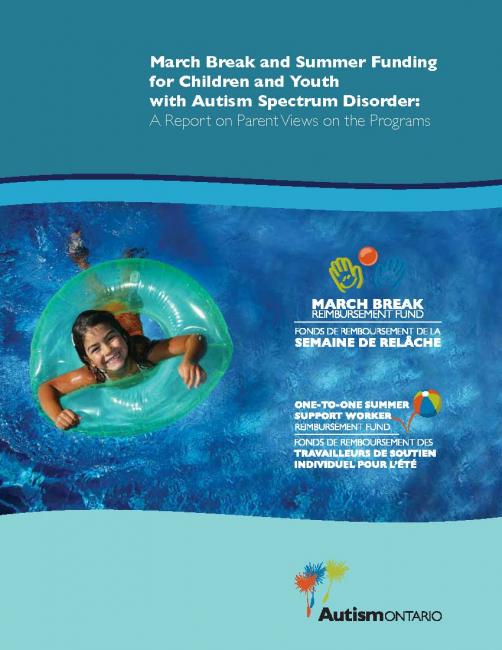
2012 March Break and Summer Funding for Children and Youth with Autism Spectrum Disorder: A Report on Parent Views on the Programs

A child floating in a pool in an inner tube with the words "March Break and Summer Funding for Children and Youth with Autism Spectrum Disorder: A Report on Parent Views on the Programs" above

This report was published in 2012.

For over 35 years, Autism Ontario has worked with the Government of Ontario towards a vision of “acceptance and opportunities for all individuals with ASD”. One initiative of Autism Ontario was to develop a program that would provide direct financial support to families of children with Autism Spectrum Disorders (ASD) to enable them to participate in community-based activities/programs throughout the Summer and March Break vacations from school, such as camps and recreational programs. Financial support for Summer funding was first provided by the Ministry of Children and Youth Services in 2007. Funding could be used by families in a variety of ways. The funding could be used by families to pay for
community recreational/camps programs or one-to-one support over March Break or one-to-one support
during summer holidays.

The direct goals of this program were: (1) to provide families with respite; (2) to support community and recreational participation of children with ASD; (3) to provide high-quality programing opportunities; and (4) to help provide continuity of care during vacation periods defined by the school calendar. Through these four primary goals, it was hoped that several secondary objectives may be achieved: (1) lower parental stress; (2) improvement in skills of the children; and (3) modest improvement in ASD symptomatology. An evaluation component of the program was initiated by Autism Ontario to measure the effective and ineffective elements of the program. This paper will provide an overview of the process involved in the
evaluation of the March Break and Summer Funding program, along with a review of the results of the evaluation. First, a very brief overview of some research supporting the importance of the identified program goals will be reviewed. Next, the evaluation process will be described, followed by a review of the results from the program evaluation. Finally, an executive summary will provide a concise overview of key messages of this evaluation.

La sexualité et le TSA_ Sylvie Grenier


Sylvie Grenier vous offre un webinaire conçu pour les parents d’un enfant/adolescent ayant un TSA. Comme parent, vous avez le rôle le plus important dans l’enseignement de la sexualité à votre enfant. Chaque jour, vous êtes les modèles de santé sexuelle, tout en communiquant vos valeurs et croyances. Les adolescents ont besoin d’avoir l’assurance qu’ils ont toujours accès à un adulte de confiance pour appuyer et guider (sans jugement) leur apprentissage envers la sexualité. Le but de ce webinaire est de communiquer les informations nécessaires à la promotion d’une saine sexualité, fondée sur les stratégies en ACA.

Webinar - Back to School Part 1: Strategies to Prepare for School Routines with Kristin Gunby and Bethany Brewin

Back to School – A Two-Part Webinar Miniseries for a Successful September Start  

As summer holidays come to an end, you may be thinking about backpacks, water bottles, and pencil cases. You may be wondering where do I start, who should I speak with, and what should I expect? This two-part mini webinar series aims to support caregivers in transitioning their child to school by building routines for success and supporting positive communication with their child’s school team. This series will provide information and strategies for parents and caregivers of children at all stages in their school journey.  

Back to School Part 1: Strategies to Prepare for School Routines with Kristin Gunby and Bethany Brewin

Join Kristin Gunby (Behaviour Analyst, M.S., BCBA) and Bethany Brewin (Occupational Therapist, M.Sc.O.T) as we discuss simple routines that you can implement at home to help students of any age make the transition to school a smooth one. In addition, we will talk about how to prepare your child for school with some planning and creativity from the comfort of your home and community. This webinar is appropriate for parents and caregivers of children of all ages. 

Additional sessions in this series: Part 2: Strategies for Connecting with your School Team

This event is part of our Back-to-School Collection, view the entire collection here: https://bit.ly/AOBackToSchool 

BB

Speaker: Bethany Brewin M.Sc.O.T.

Bethany is an experienced occupational therapist living in Simcoe County. She attended the University of Toronto for her Master of Science in Occupational Therapy. She has worked with children, youth, and families across Canada, as well as providing consultation services to childcare settings, schools, and community organizations. Bethany has presented on a variety of topics over the years, from fine motor skills to healthy eating; she was a panelist at a recent symposium on the impact of screen time on early childhood development. She is particularly passionate about connecting with the world around us through mindfulness: engaging our senses to connect with our surroundings. Bethany is part of Autism Ontario’s "Subject Matter Expert" team. 

Speaker: Kristin Gunby, M.S., BCBA, Behaviour Analyst  

KG

 Kristin is a Board Certified Behavior Analyst® (BCBA®) with over twenty years of experience supporting individuals with Autism and their families. Kristin completed her Bachelor of Arts in Linguistics at Brock University and her Master of Science in Behaviour Analysis from St. Cloud State University. Kristin has worked both privately and publicly as a clinician throughout various iterations of the Ontario Autism Program. She has also worked as an Applied Behavior Analysis Facilitator for a public-school board in Ontario. She has published studies in the Journal of Applied Behavior Analysis and Behavioral Interventions in the areas of safety skills, joint attention, and teaching presentations. Kristin is part of Autism Ontario’s newly formed “Subject Matter Expert” Team.

Disclaimer: Opinions reflected in this webinar are those of the speaker(s) and presenter(s), and do not necessarily reflect Autism Ontario’s views. Please note Autism Ontario does not endorse any specific therapy, product, treatment, strategy, opinions, service, or individual. We do, however, endorse your right to information. Autism Ontario strongly believes that it is important to do your own research and make your own informed decisions. 

Webinaire – La rentrée scolaire, partie 1 : Stratégies de préparation aux routines scolaires, avec Kristin Gunby et Bethany Brewin (en anglais)

La rentrée scolaire - Une mini-série de deux webinaires pour réussir la rentrée scolaire de septembre

Les vacances d’été touchent à leur fin, et il est temps de penser sacs à dos, bouteilles d’eau et étuis à crayons. Vous vous demandez peut-être par où commencer, à qui parler et à quoi vous attendre? Dans cette mini-série de deux webinaires, les aidants apprendront comment assurer une transition harmonieuse pour leur enfant en établissant des routines qui seront un gage de succès et en favorisant une communication positive avec l’équipe scolaire de l’enfant. Les parents et aidants d’enfants y apprendront de précieuses informations et stratégies, applicables aux diverses étapes du parcours scolaire. 

La rentrée scolaire, partie 1 : Stratégies de préparation aux routines scolaires

Kristin Gunby (analyste du comportement, M.S., BCBA) et Bethany Brewin (ergothérapeute, M.Sc. en ergothérapie) vous proposeront des routines simples à appliquer à la maison pour faciliter une transition scolaire sans heurts aux enfants de tout âge. Elles vous expliqueront également comment préparer l’enfant pour le retour à l’école dans le confort de votre foyer et de votre communauté, avec un peu de planification et de créativité. Ce webinaire s’adresse aux parents et aidants d’enfants de tout âge. 

Séances supplémentaires dans cette : Partie 2 : Stratégies pour nouer des liens avec votre équipe scolaire (en anglais)

Cette activité fait partie de notre collection de la rentrée scolaire. Pour voir l’ensemble de la collection : https://bit.ly/3XhQxGN 

BB

Conférencière : Bethany Brewin M.Sc. en ergothérapie

Bethany est une ergothérapeute chevronnée qui habite le comté de Simcoe. Après avoir a obtenu sa maîtrise en sciences (ergothérapie) à l’Université de Toronto, elle a travaillé auprès d’enfants, d’adolescents et de familles un peu partout au Canada, en plus de fournir des services-conseils à des garderies, des écoles et des organismes communautaires. Au fil des ans, Bethany a présenté des conférences sur divers sujets, allant de la motricité fine à l’alimentation saine; elle a récemment été panéliste à un symposium sur l’impact du temps d’écran sur le développement des jeunes enfants. Elle s’intéresse avec passion à l’importance de s’ancrer dans le monde par la pleine conscience : mobiliser nos sens pour se connecter à notre environnement. Bethany fait partie de l’équipe d’« experts en la matière » d’Autisme Ontario. 

Conférencière : Kristin Gunby, M.S., BCBA, analyste du comportement   

KG

Kristin est analyste du comportement agréée (BCBA®) qui compte plus de vingt années ans d’expérience auprès de personnes autistes et de leurs familles. Elle a obtenu un B.A. en linguistique de la Brock University et une M.Sc. en analyse du comportement de la St. Cloud State University. Elle a travaillé comme clinicienne dans les secteurs privé et public au fil des différentes moutures du Programme ontarien des services en matière d’autisme, et elle a également travaillé comme facilitatrice de l’analyse comportementale appliquée pour un conseil scolaire public en Ontario. Elle a publié des recherches dans le Journal of Applied Behavior Analysis and Behavioral Interventions concernant les aptitudes en sécurité, l’attention conjointe et les types d’enseignements. Kristin fait partie de la nouvelle équipe d’experts en la matière d’Autisme Ontario.

Déni de responsabilité : Les opinions exprimées dans ce webinaire sont celles des conférenciers et des présentateurs et ne reflètent pas nécessairement les points de vue d’Autisme Ontario. Prenez note qu’Autisme Ontario ne donne son appui à aucun produit, thérapie, traitement, stratégie, opinion, service ou individu en particulier. Nous appuyons cependant votre droit à l’information. À nos yeux, il est très important que vous fassiez vos propres recherches afin de prendre vous-même des décisions éclairées.  

Webinar - Back to School Part 2: Strategies for Connecting with your School Team with Tracie Lindblad and Danielle Nolan

Back to School – A Two-Part Webinar Miniseries for a Successful September Start  

As summer holidays come to an end, you may be thinking about backpacks, water bottles, and pencil cases. You may be wondering where do I start, who should I speak with, and what should I expect? This two-part mini webinar series aims to support caregivers in transitioning their child to school by building routines for success and supporting positive communication with their child’s school team. This series will provide information and strategies for parents and caregivers of children at all stages in their school journey.

Session 2 of 2: Back to School: Strategies for Connecting with your School Team

Join Tracie Lindblad (Speech-Language Pathologist, M.Sc. Reg. SLP, M.Ed., BCBA) and Danielle Nolan (Social Worker, MSW RSW) as we discuss strategies for setting your child and their team up for success. This webinar aims to support caregivers in understanding what to expect in the first 60 days of school, and how best to connect with your child’s school. We will provide background information on the various meetings, documents, and assessments that may involve your child. This webinar is appropriate for parents and caregivers of children of all ages. 

Additional sessions in this series: Part 1: Strategies to Prepare for School Routines 

This event is part of our Back-to-School Collection, view the entire collection here: https://bit.ly/AOBackToSchool 

Speaker: Tracie Lindblad, M.Sc., Reg. SLP (CASLPO), M.Ed., BCBA

Tracie Lindblad

Tracie is a dually credentialed Speech-Language Pathologist and Board Certified Behavior Analyst® (BCBA®) with over 35 years’ experience working within school settings, not-for-profit agencies, and private practice.  She has extensive experience working with children, youth, and adults with developmental disabilities, severe problem behaviour, ASD, complex communication needs, and dual diagnosis. Tracie blends her skills from speech-language pathology, education, behaviour analysis, research, and business to increase client outcomes and has worked with clients and companies throughout North America, Europe, and the UK. Tracie is actively involved in applied research across the fields of speech-language pathology and behaviour analysis and has been fortunate to be involved in large cross-sector research studies involving individuals with developmental disabilities, autism, and aphasia. She also currently serves as a director on a number of Boards for organizations in Ontario.


DN

Speaker: Danielle Nolan, MSW., RSW

Danielle is the Social Worker on Autism Ontario’s newly formed, Subject Matter Expert team. She lives in the East Region and has a particular interest in supporting rural populations. She completed her Master of Social Work designation at the University of Toronto where she gained practicum experience at the Hospital for Sick Children. Over the past 7 years, Danielle has worked in child welfare and children’s treatment. Most recently, Danielle was the social worker in an Autism Hub. She provided brief- and on-going emotional and instrumental support to children with ASD and their families. 

Disclaimer: Opinions reflected in this webinar are those of the speaker(s) and presenter(s), and do not necessarily reflect Autism Ontario’s views. Please note Autism Ontario does not endorse any specific therapy, product, treatment, strategy, opinions, service, or individual. We do, however, endorse your right to information. Autism Ontario strongly believes that it is important to do your own research and make your own informed decisions. 

Please note that as of July 1, 2024, to practice ABA in Ontario, Behaviour Analysts must be registered with the College of Psychologists and Behaviour Analysts of Ontario (CPBAO) and will be referred to as Registered Behaviour Analysts (RBAs). Individuals may use the BCBA and BCBA-D credential if they are also registered with the CPBAO.