Research Participation Opportunities
Cette page n’est pas disponible en français, cliquez ici pour voir la page en anglais
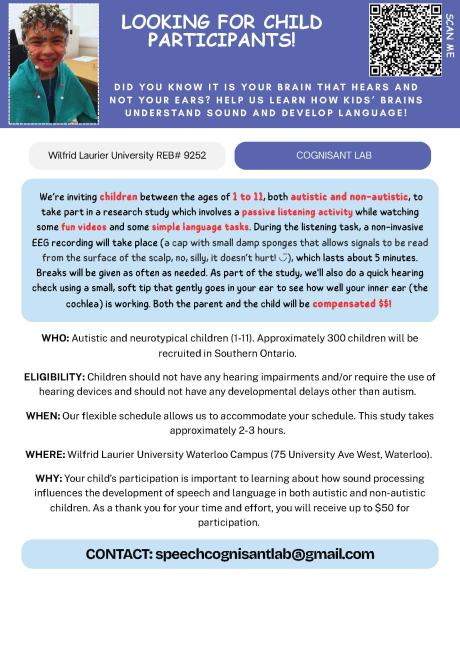
Developing a Coding System to Identify Positive Parenting Strategies for Autistic Adolescents
Institution hosting the research: A graduate student at McMaster University in Hamilton, Ontario, supervised by Dr. Teresa Bennett at the Offord Centre for Child Studies.
Study purpose: To learn about what parents/caregivers do that helps their Autistic youth feel supported and understood, and how they help their youth as they mature through adolescence. This research will inform how parenting and positive parent-child interactions can support the mental health of Autistic youth.
Participant eligibility criteria: Autistic youth aged 11-19; Caregivers/parents of an Autistic youth aged 11-19; sufficient knowledge of English to complete the interview and questionnaires.
Participation details: Participants will complete a short background questionnaire and a 30-60 minute interview at a time that works for them. Interviews can take place over Zoom or in-person in Hamilton, Ontario.
Compensation: Participants will receive a gift card as a thank-you for their time
Contact information: To learn more and/or find out if you qualify, please scan the QR code on the poster below that applies to you (youth or parent/caregiver), or follow the links below:
Link for Autistic youth: https://neuroaffirmingparenting.mcmaster.ca/surveys/?s=FECX8J8LC4DEE8AY
Link for parents/caregivers: https://neuroaffirmingparenting.mcmaster.ca/surveys/?s=AE7KE8DKCA7MF9MJ
A member of the research team will contact you to tell you more about the study and answer any questions. Filling out the form does not mean you are agreeing to take part, only that you are agreeing to be contacted to learn more. Questions? Email Kaela Franco at franck10@mcmaster.ca.
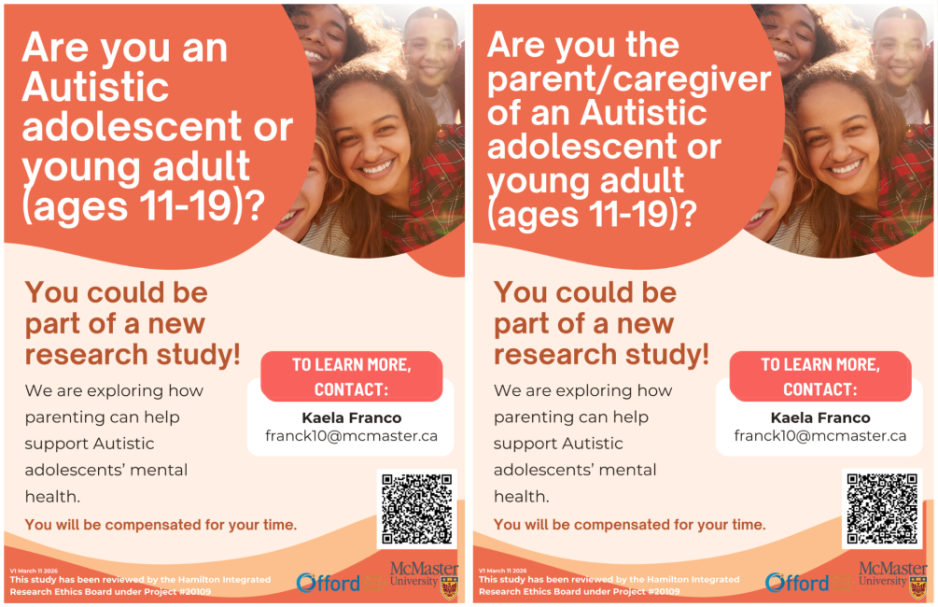
Participate in a Research Study: Autistic Young People’s Experiences of Avoidant/Restrictive Food Intake Disorder or Severe Picky Eating
We are researchers at the University of Calgary seeking participants for a study exploring the experiences of Autistic youth and young adults with ARFID and ARFID treatment. We are asking participants to complete a short survey and then participate in a virtual interview (60-90 minutes). The interview will focus on your experiences with ARFID/severe picky eating and your experiences with treatment. Participants will be compensated for their time and expertise. You may be eligible if you:
- Are a 15- 24-year-old living in Canada
- Have a formal diagnosis of Autism without intellectual disability
- Have experienced or are currently experiencing ARFID or severe picky eating
- Have accessed treatment for ARFID or severe picky eating before age 18
- Can communicate comfortably in English and have access to stable internet
- Are able to participate independently in a virtual interview
For more information, please contact: jill.gerlof@ucalgary.ca
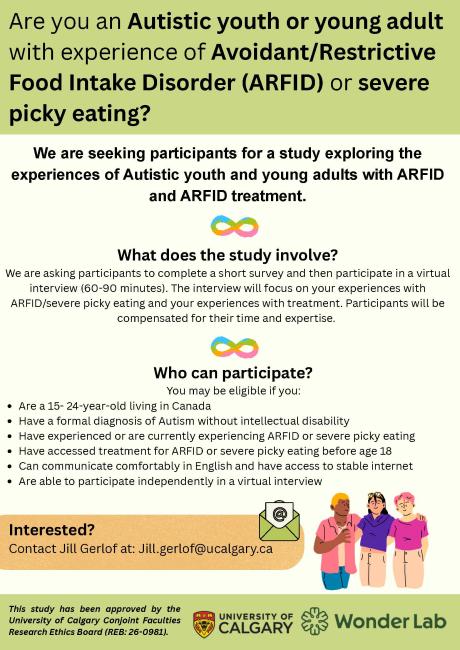
The Interplay Between EMI Conversations and Neurodiversification in Higher Education
Maria Grzegorzewska University in Warsaw, Poland, invites neurodivergent native speakers of English from Canada and the United States to participate in a research study entitled “The Interplay Between EMI Conversations and Neurodiversification in Higher Education.”
The aim of the study is to investigate the potential of online English-language conversations between Polish academic teachers and neurodivergent native speakers of English as an intervention that simultaneously develops teachers’ English-Medium Instruction (EMI) competencies and strengthens neurodivergent participants’ self-esteem and sense of agency. Teachers’ EMI competencies include linguistic and communicative proficiency, confidence, and teaching self-efficacy in using English.
Who can participate? Neurodivergent adults who are native speakers of English and live in Canada or the United States may be eligible.
What does participation involve? Interested individuals will first complete screening questionnaires to determine their eligibility. Those who qualify will take part in 20 online conversation sessions with a Polish academic teacher via Microsoft Teams. Each session will last 45 minutes, with sessions held approximately twice a week over three months. Participants will also complete three online surveys: before the sessions, after the sessions, and approximately 4–6 weeks later. They will additionally take part in an individual interview lasting about 15 minutes and a focus group interview lasting about 30 minutes.
Compensation: Participants who complete the full study cycle will receive an Amazon.ca gift card voucher worth PLN 800 (converted to CAD based on the exchange rate at the time of issuance).
To learn more, contact Izabela Mikołajewska, PhD, at imikolajewska@aps.edu.pl
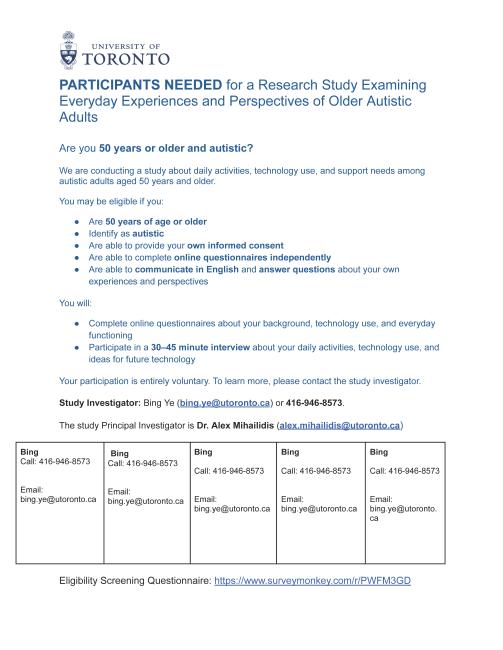
Are you 50 years or older and autistic?
The University of Toronto is conducting a study about independence in daily activities, technology use, and support needs among older autistic adults. As technology becomes more and more important in our everyday lives, there is a growing need for more research which focuses on how these tools can be specifically designed to support aging, particularly for autistic users.
If you choose to participate, you will be asked to:
- Complete a 20–30-minute online survey about your general background and experience with using different types of technologies/tools.
- Complete a 10-15 minute online survey where you will be asked to reflect on your day-to-day activities and general habits.
- Participate in a 30-45 minute interview (conducted remotely, or in-person, according to your preference) where you will be asked to describe and elaborate on your experiences with everyday activities, technology, and other relevant topics.
Once you complete the interview, you will receive $30 for participating in this study. This can be mailed to you in cash, or sent immediately to your bank account through electronic transfer, according to your preference.
If you are 50 years of age or older, identify as autistic, are able to complete 2 online surveys and participate in a 30-45 minute interview, and are interested in participating , please contact a member of the research team directly by e-mail or telephone, using any one of the email addresses or phone numbers provided below:
Primary Study Contact: Laura Calugaru
lcalugar@uoguelph.ca
647-636-3133
Secondary Study Contact: Bing Ye
bing.ye@utoronto.ca
416-946-8573
Secondary Study Contact: Alex Mihailidis
alex.mihailidis@utoronto.ca
416-978-0888
Call for Participants: School Attendance in Autistic Children
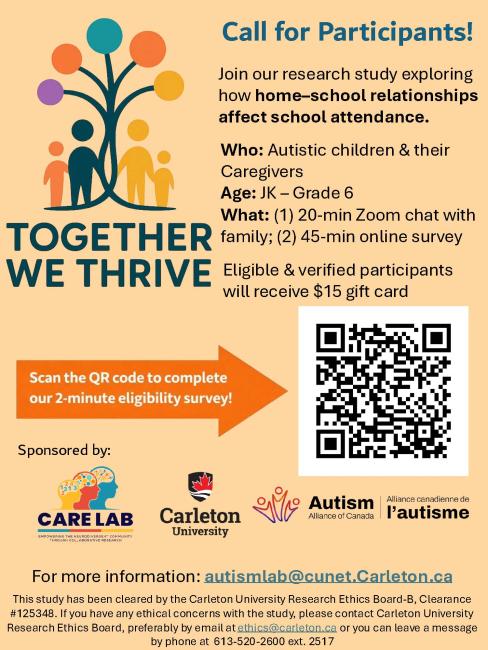
Do you care for a school-aged Autistic child in in Canada? The Carleton Autism Research Laboratory at Carleton University is looking for families to join our research study exploring how home-school relationships affect school attendance in children in kindergarten to grade 6. Families will take part in a 20-minute online meeting with their child and complete a 45-minute survey. Eligible and verified participants will receive $15 in gift cards.
Scan the QR code below to take our 2-minute eligibility survey or click the following link:
https://carletonu.az1.qualtrics.com/jfe/form/SV_23TS73B0WhL79hI
For more information, please contact Jennifer Crookshank at autismlab@cunet.Carleton.ca
NOTE: This study has been cleared by the Carleton University Research Ethics Board-B, Clearance #125348. If you have any ethical concerns with the study, please contact Carleton University Research Ethics Board, preferably by email at ethics@carleton.ca or you can leave a message by phone at 613-520-2600 ext. 2517
Exploring How Au/DHD Young Adults in Hamilton, ON Navigate Wellbeing and Employment
Institution hosting the research: The School of Earth, Environment, and Society at McMaster University
Study purpose & research questions: This study is investigating Autistic and ADHD Young Adult Employment and Wellbeing. Their team is conducting research about the experiences Autistic and ADHD adults between the ages of 18 and 29 have with employment, accessibility of work roles, and how these influence overall wellbeing.
Participant eligibility criteria: Must be between 18-29 years old, live and work in Hamilton, ON, and identify with as Autistic and/or with ADHD. A formal diagnosis is not required so long as a person self identifies or suspects they may be Au/DHD, with the chance to clarify in the study.
Participation details and Compensation: This is an anonymous survey that will take approximately 30 minutes for which you will be entered into a draw for a $100.00 gift card to your choice of Walmart, Amazon, or Uber. The study will take place online using Microsoft Forms as the survey software.
You can access the survey by clicking on the following link: Exploring How Au/DHD Young Adults in Hamilton, ON Navigate Wellbeing and Employment. You will be presented with a Letter of Information followed by a consent button before the survey begins.
To receive more information about taking part in this study, please contact the lead researcher Abigail directly by using her email address, Email: AmosA1@mcmaster.ca
This study has been reviewed and received ethics clearance from the McMaster Research Ethics Board (Project # 7992).

ASD Attention-based Music Training & Language Development
Institution Hosting the Research
Music and Health Research Collaboratory (MaHRC), Faculty of Music, University of Toronto
Study Purpose & Research Questions
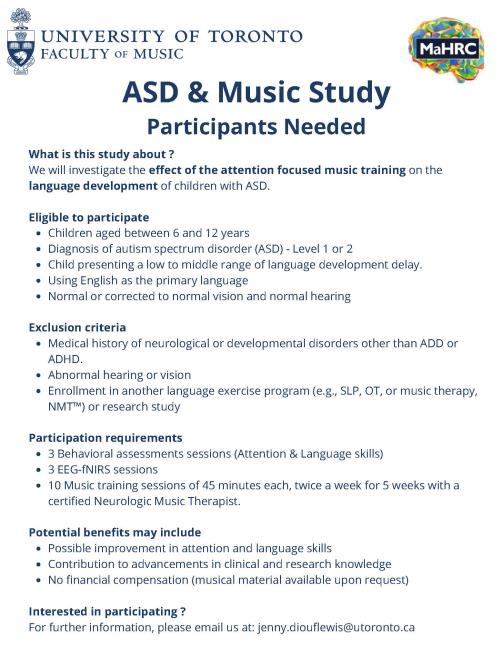
This study will investigate the effects of attention-focused music training on attention and language development in children with Autism Spectrum Disorder (ASD).
Participant Eligibility Criteria
Children may be eligible to participate if they:
Are between 6 and 12 years of age.
Have a diagnosis of Autism Spectrum Disorder (ASD), Level 1 or 2.
Have a low to moderate level of language development delay.
Use English as their primary language.
Have normal or corrected-to-normal vision and normal hearing.
Children may not be eligible if they have neurological or developmental disorders other than ADD or ADHD, abnormal hearing or vision, or are currently enrolled in another language-based intervention program (e.g., SLP, OT, music therapy, or NMT™) or another research study.
Participation Details
Participation involves three behavioural assessment sessions measuring attention and language skills, three EEG-fNIRS sessions, and ten 45-minute music training sessions. Music training will take place twice per week for five weeks and will be provided by a certified Neurologic Music Therapist.
Participation is voluntary and will take place in person at the MaHRC lab of the University of Toronto.
Compensation
There is no financial compensation for participation. Musical materials may be available upon request.
Contact Information
For more information or to express interest in participating, please email jenny.diouflewis@utoronto.ca.
Participants Needed: Help Us Understand How the Brain Thinks and Feels
Researchers at SickKids are exploring how people think, pay attention, and respond to the world around them. By including individuals with intellectual disabilities alongside those with Prader-Willi Syndrome (PWS), we can explore how brain activity relates to thinking and emotion. Your participation helps improve understanding and care for people with PWS and other developmental conditions.
Who Can Participate: Individuals aged 12 months to 60 years who are diagnosed with a neurodevelopmental or intellectual disability (e.g., Down Syndrome, Angelman Syndrome, Autism etc.), have normal or corrected vision, is able to fast safely (no health risks from fasting), have no major dietary restrictions, open to completing eye tracking and other study activities.
What's Involved: 1 research visit (at SickKids/at home), Eye Tracking and MEG, pen and paper tasks, blood or saliva sample, questions about your thoughts and mood.
Why Join: Gift card, reimbursement for travel expenses, help improve future outcomes for individuals with PWS
To learn more or sign up email recruitment.beacon@sickkids.ca

National Research Surveys on Dementia Screening for Adults with Intellectual and Developmental Disabilities - Health and Social Service Providers
Researchers at the Centre for Addiction and Mental Health (CAMH) are recruiting participants for two national surveys as part of the study Evaluating implementation of a dementia screening program for people with intellectual and/or developmental disabilities (IDD).
The study aims to understand how dementia screening is being implemented across Canada, including experiences using the NTG-Early Detection Screen for Dementia (NTG-EDSD), barriers and facilitators to screening, and how screening may be improved.
Health and social service providers may participate if they support adults with IDD aged 40 years or older, live in Canada, can communicate in English, and are able to provide informed consent.
Survey link: https://redcap.link/gxezgbta
Participation involves completing a 20 to 30 minute survey online, by telephone, or on paper. Participants may enter a raffle for a 1 in 20 chance to receive printed health or developmental disability resources.
For more information or support completing the survey, contact BrainHealthIDD@camh.ca

National Research Surveys on Dementia Screening for Adults with Intellectual and Developmental Disabilities - Family Caregivers
Researchers at the Centre for Addiction and Mental Health (CAMH) are recruiting participants for two national surveys as part of the study Evaluating implementation of a dementia screening program for people with intellectual and/or developmental disabilities (IDD).
The study aims to understand how dementia screening is being implemented across Canada, including experiences using the NTG-Early Detection Screen for Dementia (NTG-EDSD), barriers and facilitators to screening, and how screening may be improved.
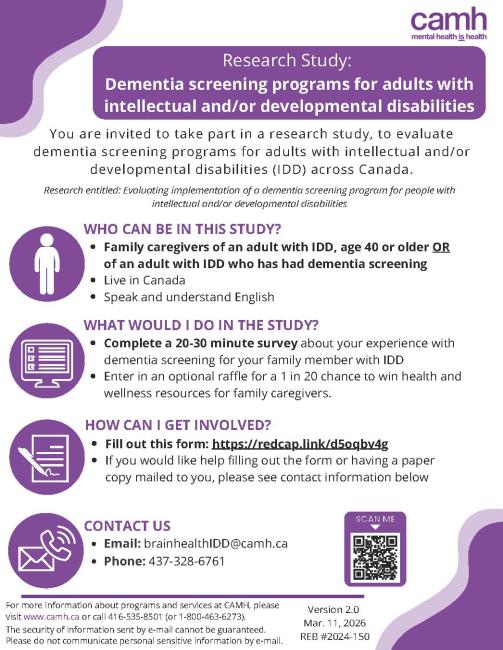
Family caregivers may participate if they support a family member with IDD who is either 40 years or older, or younger than 40 and has undergone dementia screening. Participants must live in Canada, communicate in English, and be able to provide informed consent.
Survey link: https://redcap.link/d5oqbv4g
Participation involves completing a 20 to 30 minute survey online, by telephone, or on paper. Participants may enter a raffle for a 1 in 20 chance to receive printed health or developmental disability resources.
For more information or support completing the survey, contact BrainHealthIDD@camh.ca
Integrating lived/living experience into paediatric neurodevelopmental disability health systems
Institution:
Carleton University
Study purpose:
To explore how lived/living experiences related to neurodevelopmental disabilities (NDDs) can be meaningfully integrated into health systems (i.e. healthcare, education, policy, advocacy).
Participant eligibility criteria:
*NDDs will include neurodivergence, autism, ADHD, learning disability, intellectual disability, cerebral palsy, Fragile X syndrome, or identifying with an NDD
- Lives in Canada
- Able to communicate in English
AND
1. Youth with an NDD
- 16-24 years old
- Diagnosed or self-identified with an NDD
OR
2. Parent/caregiver of a child/youth with an NDD
- At least 18 years old
- Has a child or youth with an NDD who is 0-24 years old
Participation details:
- Online demographic survey (10 min)
- If selected, you will receive an email for an individual interview via Zoom (60-75 min)
Compensation:
- Survey raffle: $50 Amazon gift cards (1 winner per group with ~1 in 20 odds)
- Interview: $40 gift card of your choice from a list (i.e. Amazon, Chapters/Indigo, Sephora, Tim Hortons, or grocery gift card)
Contact information: MADELINECHOY@cmail.carleton.ca
Recruitment video: https://drive.google.com/file/d/1n2yLOhfdf--qA6uXb2brEqMHJUzIY2Eb/view
Survey link: https://carletonu.az1.qualtrics.com/jfe/form/SV_8BUBuvcwanR5bYG
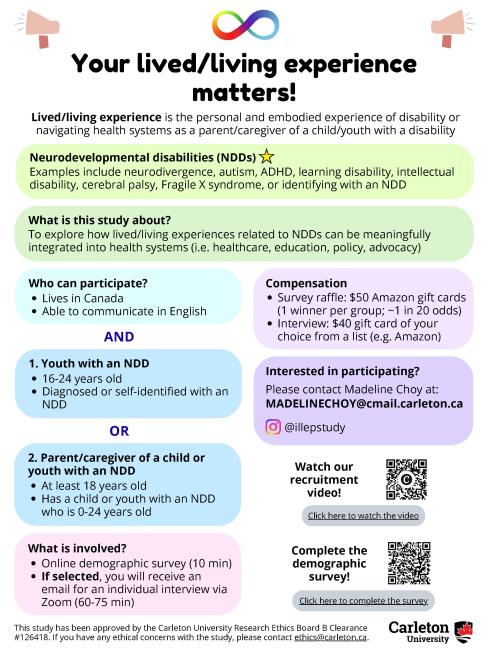
‘Getting My Vaccine – A Social Story’: A Resource to Support Vaccination Experiences for Autistic Children and Caregivers
Researchers at the University of Guelph are seeking autistic children and their caregivers to participate in a study examining families’ real-world experiences using Getting My Vaccine: A Social Story to prepare for and cope with a child’s vaccination. The study will explore participants’ satisfaction with, understanding of, and engagement with the resource, as well as how using the resource may have influenced their vaccination experience. Findings will inform future research, with the goal of making the resource freely available to families.
Who can participate? Children must have a diagnosis of autism spectrum disorder, be 7–18 years old (inclusive), have a vaccination planned or scheduled for the near future, and be located in Canada. Caregivers must be 18 years or older. Participants must speak English well enough to participate in an interview. Children do not need to be fearful of needles or have previous experience with vaccines or Social Stories.
What does participation involve? Families will first complete a screening call or meeting. If eligible, the child-caregiver pair will complete consent and a demographics questionnaire, use the Social Story to prepare for the child’s vaccination, and participate in a follow-up interview of approximately one hour after the vaccination.
Compensation: Children and caregivers who complete the study will each receive a $15 gift card to Walmart, Amazon, or Tim Hortons.
Location: Participants may be located anywhere in Canada; no specific Ontario region is required.
For more information or to express interest, please contact Olivia at odobson@uoguelph.ca.
Building Social Connections: Join a Play-Based LEGO Intervention Study
Western University is currently seeking child-caregiver pairs for a research study titled "The Effect of Play-Based Intervention on Social Communication Skills in Autistic Children." The goal of this research is to determine if a home-based LEGO intervention can effectively increase spontaneous social initiations and responses in autistic children. To be eligible, children must be between 3 and 7 years old with a formal autism diagnosis, demonstrate foundational communication skills like following one-step directions, and have a genuine interest in playing with LEGO. Participating caregivers must provide regular childcare and have no prior professional training in behaviour analysis or specialized parent training for social skills. The study is conducted entirely remotely through Zoom and includes a 1–2 week baseline phase, a 3–3.5 hour virtual training session for the caregiver, at least ten 30-40 minute LEGO building sessions, and a follow-up period. Please note that participants self-select the timing of every session. As compensation, families can receive up to $100 in Amazon gift cards and are permitted to keep the LEGO kits provided for the study. To learn more or to volunteer, please contact the primary researcher, Reilly Burnett, at rburnet6@uwo.ca.

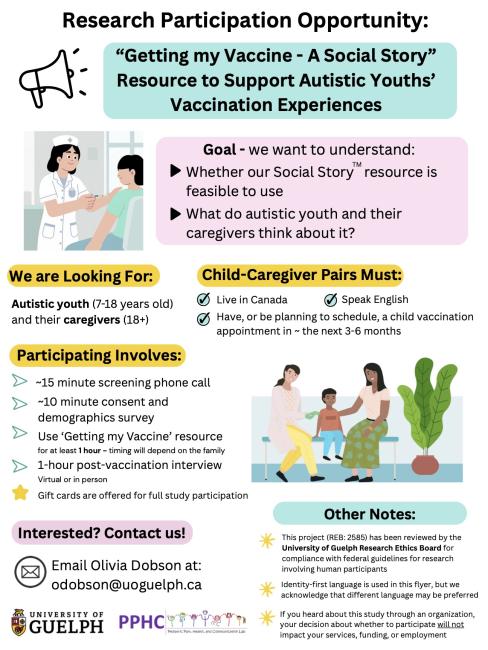
Examining Social Connectedness and Well-Being of Participants in a D&D based Social Program
The Oshawa Dungeons & Dragons Club is a social group for neurodivergent youth ages 13-18. It uses the fantasy tabletop role playing game Dungeons & Dragons (D&D) as a social medium within a neurodiversity affirming structure built on the concepts of Youth Empowerment, Mentorship, Belonging, Engagement, and Respect (EMBER).
Our research aims to gain a better of understanding of the impacts the program has on social connectedness, basic psychological needs, and social identity, of participants. Participants and a parent will fill out questionnaires before the start of the program. The youth will then take part in a 15-week in person D&D program facilitated by neurodivergent mentors. At the end of the 15-week program parents and participants will fill out the questionnaires again and will also take part in a short interview at the end of the program.
All materials needed to play will be provided to participants.
Recruitment deadline extended to July 31st!
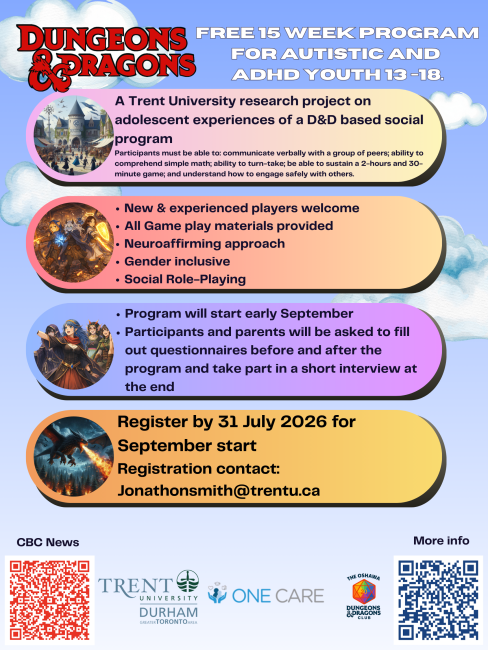
Mental Health and Masking Survey study
The SMART Lab at the University of British Columbia is conducting an online survey study to better understand the mental health and masking of autistic youth.
What does the study involve?
- A 10-minute online survey completed by a parent. The survey will include background questions (e.g., age, gender, education) and an autism traits questionnaire
- A 15-minute online survey completed by an autistic youth. The survey will include an autism traits, anxiety, depression, stress, and masking questionnaire.
Who can participate?
- Both a parent and autistic adolescent/youth must participate in the study.
- Adolescent/Youth must 1) be 13 to 21 years old, 2) have an autism diagnosis, 3) live in Canada, USA, England, or Australia, and 4) no diagnosis of intellectual disability.
Will there be compensation?
- Families will have the opportunity to enter a draw for a chance to win one of 10 $50CAD e-gift cards to thank you for your time.
What is the next step?
- Please complete a 2-minute screener to see if you can participate in the study using the following link: https://ubc.ca1.qualtrics.com/jfe/form/SV_4V20HTRZw8HJTfM
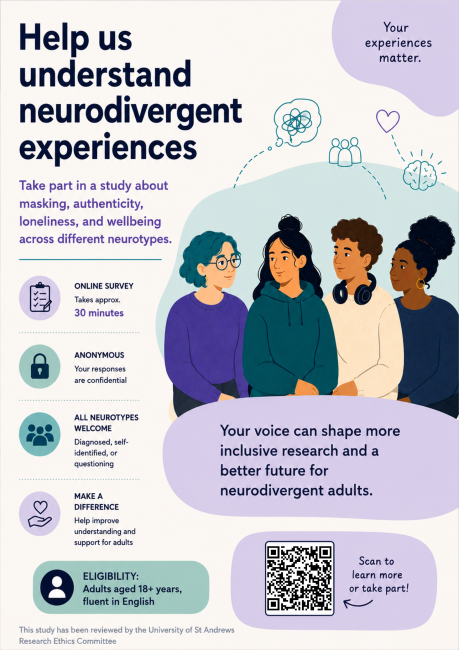
Online Survey on Masking, Authenticity, Loneliness, and Wellbeing
Researchers at the University of St Andrews are inviting adults to take part in an anonymous online survey about social experiences, masking/camouflaging, authenticity, loneliness, and wellbeing.
The study explores how experiences such as adapting behaviour, managing social expectations, feeling misunderstood, feeling able to be oneself, and accessing socially compatible relationships may relate to loneliness and wellbeing.
Participation is open worldwide to adults aged 18 or over who are fluent in English. Autistic, ADHD, AuDHD, otherwise neurodivergent, questioning, and non-neurodivergent adults are all welcome to take part. A formal diagnosis is not required.
The survey takes approximately 20–30 minutes and includes rating-scale questions, with optional open-text questions for participants to share anything the survey does not fully capture.
This study has received favourable ethical approval from the University of St Andrews School of Psychology and Neuroscience Ethics Committee: PS-1735-2378-2026.
Survey link: https://standrews.eu.qualtrics.com/jfe/form/SV_4GXNtlTqIxBgvXM
Ontario School Inclusion Survey
Community Living Ontario is partnering with Jess Whitley at the University of Ottawa to conduct a survey and interviews to better understand children’s inclusive schooling experience. We learned a lot from the survey in 2022/23 and we're hoping to continue learning! We are interested in hearing about your child(ren)’s experiences with inclusion – including specific questions about exclusion, seclusion, and restraint.
The survey is for families whose child(ren) are attending school in Ontario this school year (September 2025- June 2026), whether or not they have experienced inclusion, exclusion, seclusion or restraint. It will take between 5 and 25 minutes to complete, depending on your experiences and how much information you choose to share. You can also choose to chat with our team via an interview. The information you share is anonymous, and the data will be owned by the research team. As a thank you, you can enter a draw to win one of thirty $15, five $25, or one $100 Amazon gift cards (total value: $675).
If you have any questions about the survey, you can contact Jess and her team at inclus@uottawa.ca or Shawn Pegg at Community Living Ontario at shawn@communitylivingontario.ca or 416-447-4348.
Click here to learn more and get started: https://www.jesswhitley.ca/2026osis
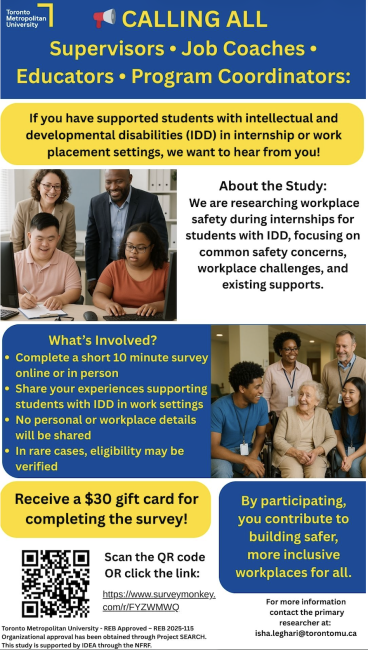
Research Study: OHS Risks for Students with Intellectual and Developmental Disabilities in Work Placements
Researchers at Toronto Metropolitan University are conducting a study about occupational health and safety risks for students with intellectual and developmental disabilities in internship, co-op, experiential learning, and work placement settings.
The purpose of this study is to better understand the types of workplace hazards, barriers, supervision practices, accommodations, and supports that may affect students with intellectual and developmental disabilities, including autistic students, during work placements. The study asks how educators, coordinators, supervisors, job coaches, and other professionals perceive occupational health and safety risks and what strategies may support safer and more inclusive placement experiences.
You may be eligible to participate if you are 18 years of age or older and have experience supporting, supervising, coordinating, educating, or working with students with intellectual and developmental disabilities in work placement settings. Participants from across Ontario are welcome.
Participation involves completing an online survey that takes approximately 15–20 minutes. The survey includes questions about placement settings, hazards, barriers, training, supervision, accommodations, and incident response. Participation is voluntary.
Eligible participants who complete the survey will receive a $30 Amazon gift card.
For more information, please contact Isha Leghari at [isha.leghari@torontomu.ca].
Developing a measure of self-injury and aggression
We’re looking for parents, teachers, and care workers to complete our measure of self-injury and aggression that has been designed for people who have a close relationship with an individual with complex needs. Our goal is to validate this measure so that it can be used for assessment and guiding treatments for aggression and self-injury.
Participation involves completing our anonymous questionnaire about the frequency, severity, and circumstances surrounding the occurrence of these behaviours. Participation is completely online and takes approximately 20 minutes.
You can complete our measure by copying and pasting this link into your internet browser. This can be completed from a computer or phone. https://yorku.questionpro.ca/t/AB3uq86ZB3vBfX
This study is being conducted by researchers at York University. You can contact us at safeaid@yorku.ca for any questions related to participation.
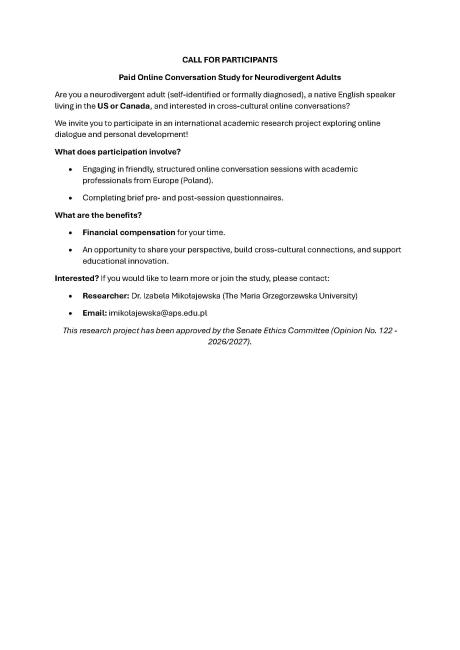
How Do Children’s Brains Process Sound? Understanding Language Development in Autism
Institution:
Wilfrid Laurier University – Cognisant Lab, Department of Psychology
Study Purpose:
We are conducting a study to better understand how children’s brains process sounds and how this relates to language development. Specifically, we are exploring whether a child’s auditory brain response (AEP-age) provides a better indicator of language ability than chronological age. The goal is to improve how we assess and support communication development in autistic and non-autistic children.
Participant Eligibility:
We are seeking children aged 3 to 13 years, both autistic and typically developing, No hearing impairments or developmental delays other than autism or seizure disorders.
Participation Details:
Each child will take part in a single EEG session at Wilfrid Laurier University in Waterloo. During the session, children will listen to gentle tones while wearing a comfortable EEG cap, the child will then complete language assessments (approx. 2-3 hours total). Parents will also complete short questionnaires about their child. Breaks, snacks, and accommodations are always provided to ensure comfort.
Compensation:
Families will receive up to $50 compensation to thank them for their time.
Contact:
For more information or to participate, please contact Maya Jovic at speechcognisantlab@gmail.com